
Master painter in the St. Annen Museum
Heute genieße ich ein ganz besonderes Privileg: ich darf schon mal vorab im Lübecker St. Annen Museum einen Blick hinter die Kulissen der neuen Ausstellung „Cranach-Kemmer-Lübeck – Meistermaler zwischen Renaissance und Reformation“ werfen, die am 24.10. eröffnen und bis 06.02.2022 zu sehen sein wird.
I am given a tour by the museum director, Dr. Dagmar Täube, through the newly prepared and technologically advanced rooms, where intense work is underway in the days leading up to the opening. Valuable loans arrive daily. Some of the museum's own works are already in place. Dr. Täube offers me a glimpse into a world she navigates with remarkable ease as a specialist in medieval art, particularly that of the 15th and 16th centuries. Her eyes sparkle as she speaks of the great reformers and influential Lübeck figures who lived hundreds of years ago, as if she had just been chatting with them.
Hidden champion – Hans Kemmer
Dr. Täube confessed to me that even she hadn't heard of Kemmer until a few years ago. When she took over the management of the museum five years ago, she discovered two somewhat neglected works by Kemmer in the permanent exhibition in the cloister, both in poor condition. Her curiosity was piqued. This led to research, investigations, and exchanges with colleagues around the world about this Lübeck painter, who had been forgotten after his death. The complexity of the subject captivated her. So much so that, after only 18 months of intensive preparation, the Lübeck exhibition will open its doors in just a few days. Kemmer is a rediscovery and a gift to Lübeck.
The exact birthdate of the Renaissance painter Kemmer is unknown, but it is estimated to be between 1495 and 1500. It is believed that Kemmer continued his apprenticeship, begun in Lübeck, in the Wittenberg workshop of Lucas Cranach the Elder between 1515 and 1520. That Kemmer worked for Cranach and was one of his most important pupils can be determined from underdrawings revealed by infrared reflectography. The exhibition uses various examples to demonstrate how this specialized camera works. Kemmer's style was concise and individual – like handwriting. He sketched outlines and details onto the canvas with sweeping strokes. Works with similar underdrawings were also found in Cranach's workshop.

With the skills he had perfected in Wittenberg, but above all with fresh impressions from the center of the burgeoning Reformation, Hans Kemmer returned to Lübeck in 1520. There, in 1522, he married the widowed painter Anneke Wickhorst and took over the workshop of her recently deceased husband. It was common practice at the time for a craftsman's widow to marry a journeyman after his death. A win-win situation, so to speak, as the widow was well provided for, and the journeyman gained his own workshop. Kemmer quickly established a strong network in Lübeck, received commissions from wealthy Lübeck families, and in 1528 was able to purchase a house in an exclusive location at Königstraße 34. Even after the Reformation, which reached Lübeck in 1531, his success continued. He adapted Cranach's visual language to Lübeck's sensibilities. He painted portraits of prominent merchants and represented the painters and glaziers on the Lübeck council as an alderman. Hans Kemmer died on August 2, 1561, and was buried in St. Catherine's Church. Afterwards, his name faded into obscurity. Today, 29 works by Kemmer are known. 460 years after his death, 22 of them are being exhibited publicly, some for the first time. The works are on loan from private collections, from several neighboring European countries, and one from the USA.
Superstar Lucas Cranach the Elder
Zu Cranach gab und gibt es unzählige Ausstellungen und eine umfangreiche Forschung, darunter das Cranach Digital Archive. Eine Plattform, die auch der interessierten Öffentlichkeit Zugang zu dem Multitalent Cranach verschafft: https://lucascranach.org/ Mehr als 1.500 Gemälde Cranachs sind erhalten. Cranach hatte eine florierende Werkstatt in Wittenberg, und malte Motive in Serie. Oder besser: häufig ließ er seine Gesellen malen. Er war bekannt in ganz Sachsen, wurde neun Mal zum Bürgermeister Wittenbergs gewählt, besaß einen Weinhandel, eine Buchdruckerei, eine Apotheke, zahlreiche Immobilien und war auf das engste mit Martin Luther, Philipp Melanchthon und Georg Spalatin verbunden. Und eben diesen prägenden Zeitgenossen begegnete auch Hans Kemmer in der Werkstatt Cranachs.
The times they are a-changin
Cranach and Kemmer lived in exciting times. Well, when in human history has it ever been boring? At the end of the 15th and into the 16th century, at least, a great deal was happening. With new scientific discoveries, the discovery of America, the invention of printing, and Luther's translation of the Bible, society was changing, and more people were able to participate in social and political processes. A time of upheaval in the transition from the Middle Ages to the modern era.
Provisions for the afterlife no longer dominated people's lives. New themes and their interpretation by contemporary artists became relevant. While Renaissance artists had primarily portrayed praying donors, the focus now shifted to humankind as self-reliant beings.
sneak preview
Was erzählen mir also die Gemälde von Kemmer und Cranach? Da ist z.B. das Portrait des Bergenfahrers Hans Sonnenschein. Er zeigt sich uns hutlos mit der Lebensfrucht in der Hand. Das Bild ist stark übermalt. Im Original, das ca. von 1534 stammt, trug er einen Hut und eine Schriftrolle in der Hand. Nach seinem Tod hat seine Witwe das Bild vermutlich zum Epitaph umarbeiten lassen. Die einzige Möglichkeit, an einen Verstorbenen bildlich zu erinnern. Ohne solche Bilder wüssten wir nicht, wie bekannte Lübecker Bürgerinnen und Bürger aussahen, welche Kleidung sie trugen, mit welchen Accessoires sie sich schmückten.

Das wohlhabende Stifterehepaar Timmermann Kruselmann hat Hans Kemmer mit der Anfertigung einer hölzernen Hochzeitsschüssel für die Tochter beauftragt, in der die Brautgaben der Gäste gesammelt werden sollten. Das Exponat ist eine Leihgabe aus Schwerin. Das Paar selbst ließ sich auf einem Gemälde von 1537 von Kemmer betend ganz selbstbewusst im Zentrum des Bildes mit Jesus als Salvator Mundi über ihnen schwebend portraitieren.
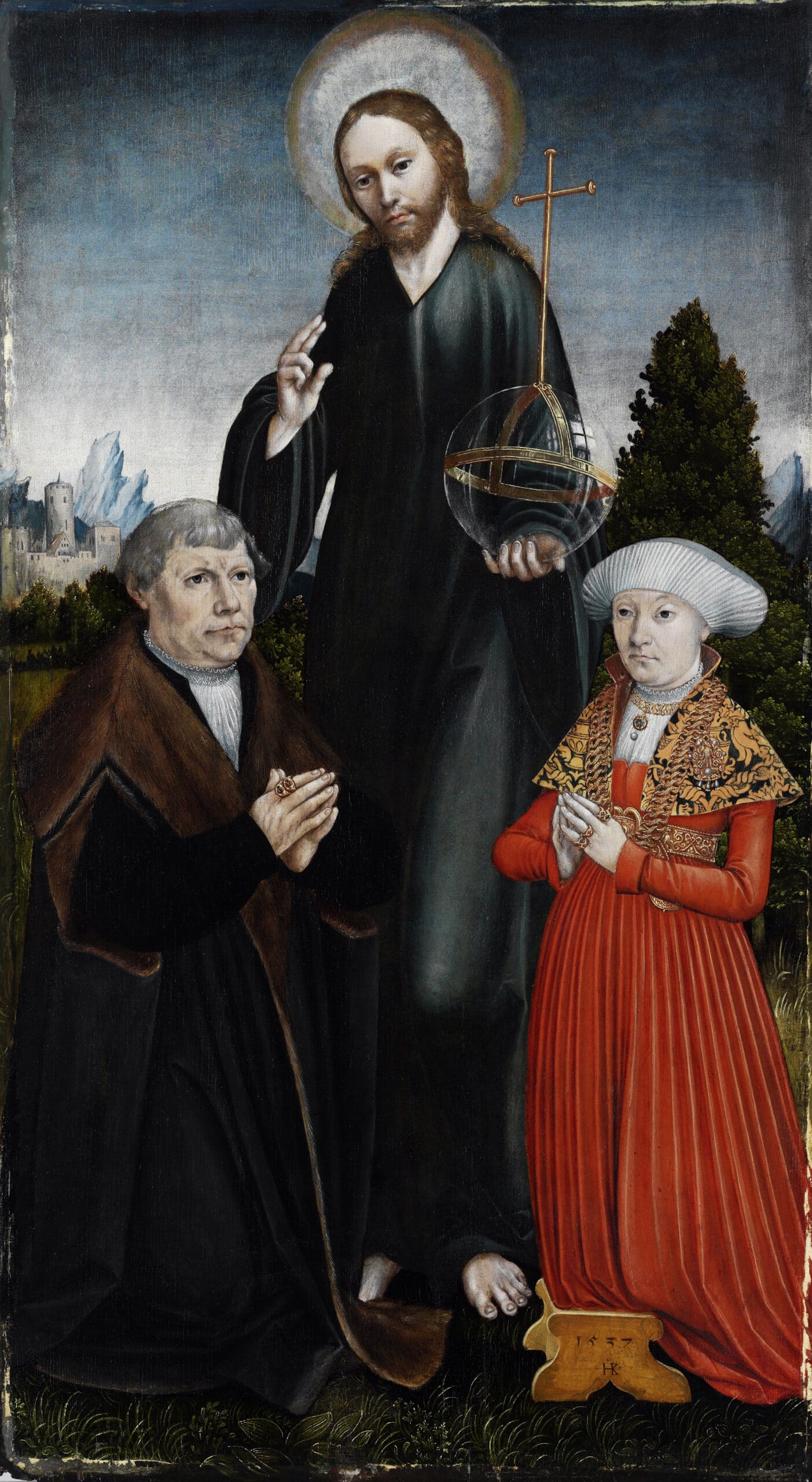
Hans Kemmer, Salvator Mundi, 1537, Lower Saxony State Museum Hanover, © Lower Saxony State Museum Hanover – Art Library 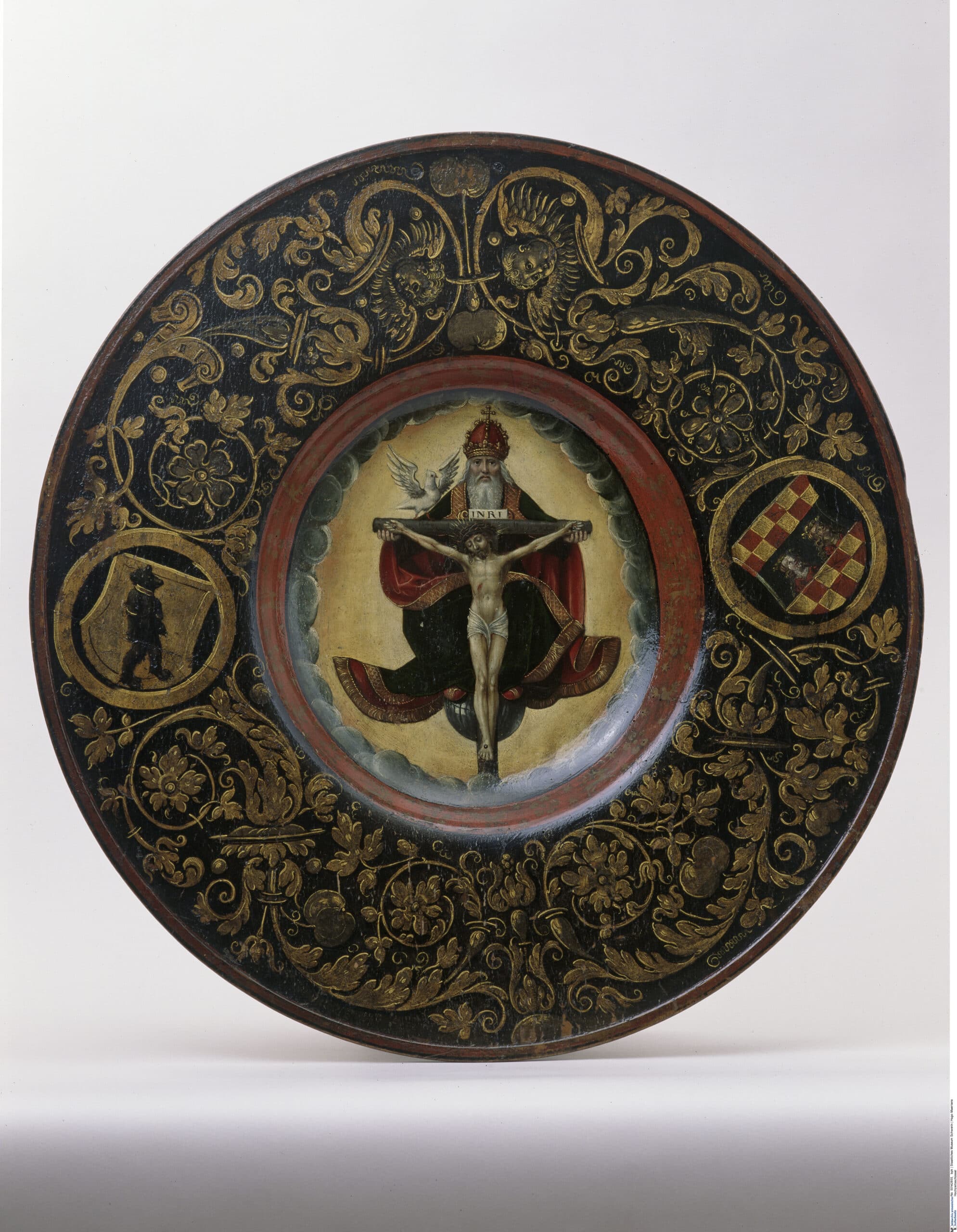
Hans Kemmer, Timmermann's Wedding Bowl, 1540, Schwerin State Museum SSGK, © Schwerin State Museum SSGK, Photo Gabriele Bröcker
Die Liebesgabe ist das einzige weltliche Bild Kemmers. Das Museum hat es erst 2018 aus einer testamentarisch verfügten Spende bei Sothebys ersteigern können. Es zeigt den Kaufmann Johann Wigerinck und seine Braut Agneta Kerckring im Moment des Ringtausches. Die Bildkomposition mit der weiten Landschaft, dem Gebüsch und dem Pferd hinter dem Baum übernahm Kemmer von Cranach. Die Eltern der Braut waren übrigens bekannte Lübecker und Stifter des Kerckring-Flügelaltars, der im Erdgeschoss im St. Annen-Museum zu sehen ist.
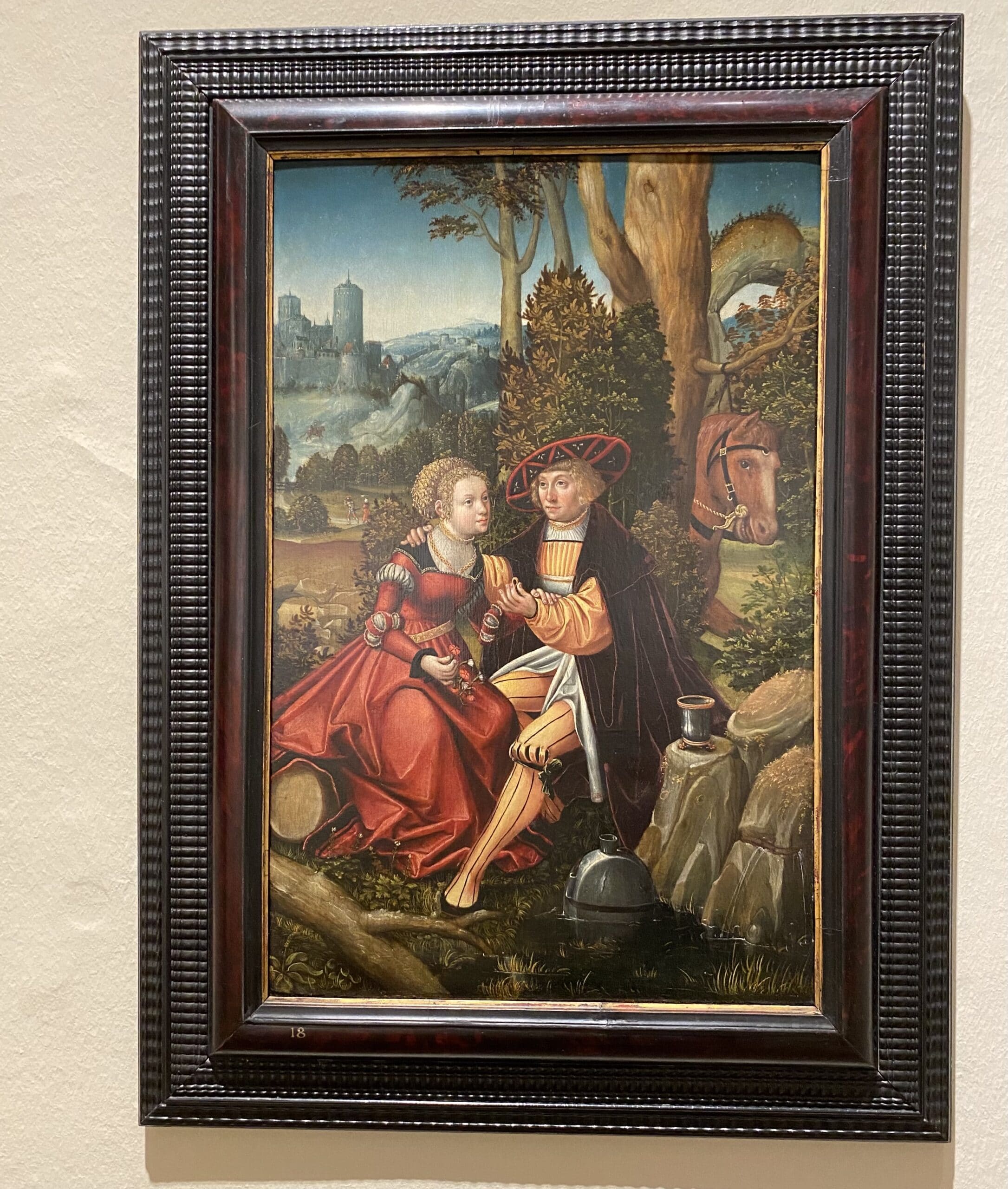
Hans Kemmer, Gift of Love, c. 1529 St. Anne's Museum, Lübeck
Derselbe Johann Wigerinck beauftragte Kemmer um 1529 auch mit dem Gemälde „Christus und die Ehebrecherin“, in dem er sich selbst abbilden ließ – und zwar als Johannes der Evangelist, der direkt hinter Jesus steht und damit auf der fortschrittlichen Seite derer, die die Ehebrecherin nicht steinigen wollen, sondern nach dem Motto „Wer ohne Sünde ist, der werfe den ersten Stein“ für die Sünderin Partei ergreifen.

Mein Lieblingsmotiv der Ausstellung stammt von Cranach. „Christus und Maria“ heißt es und bei meinem Besuch hängt es noch nicht einmal. Es wird in Kürze aus Gotha in Lübeck erwartet. Doch selbst das Foto des auf Pergament gemalten minimalistisch gestalteten Bildes nimmt mich augenblicklich gefangen. Dieser intensive Blick Jesu. Seine Nahbarkeit. Die Frauenfigur ist möglicherweise Maria Magdalena. Und die beiden wirken wie ein Paar. Sie mit einem leicht schräg gehaltenen Kopf. Sie schaut selbstbewusst. Eine revolutionäre Darstellung zu damaliger Zeit.
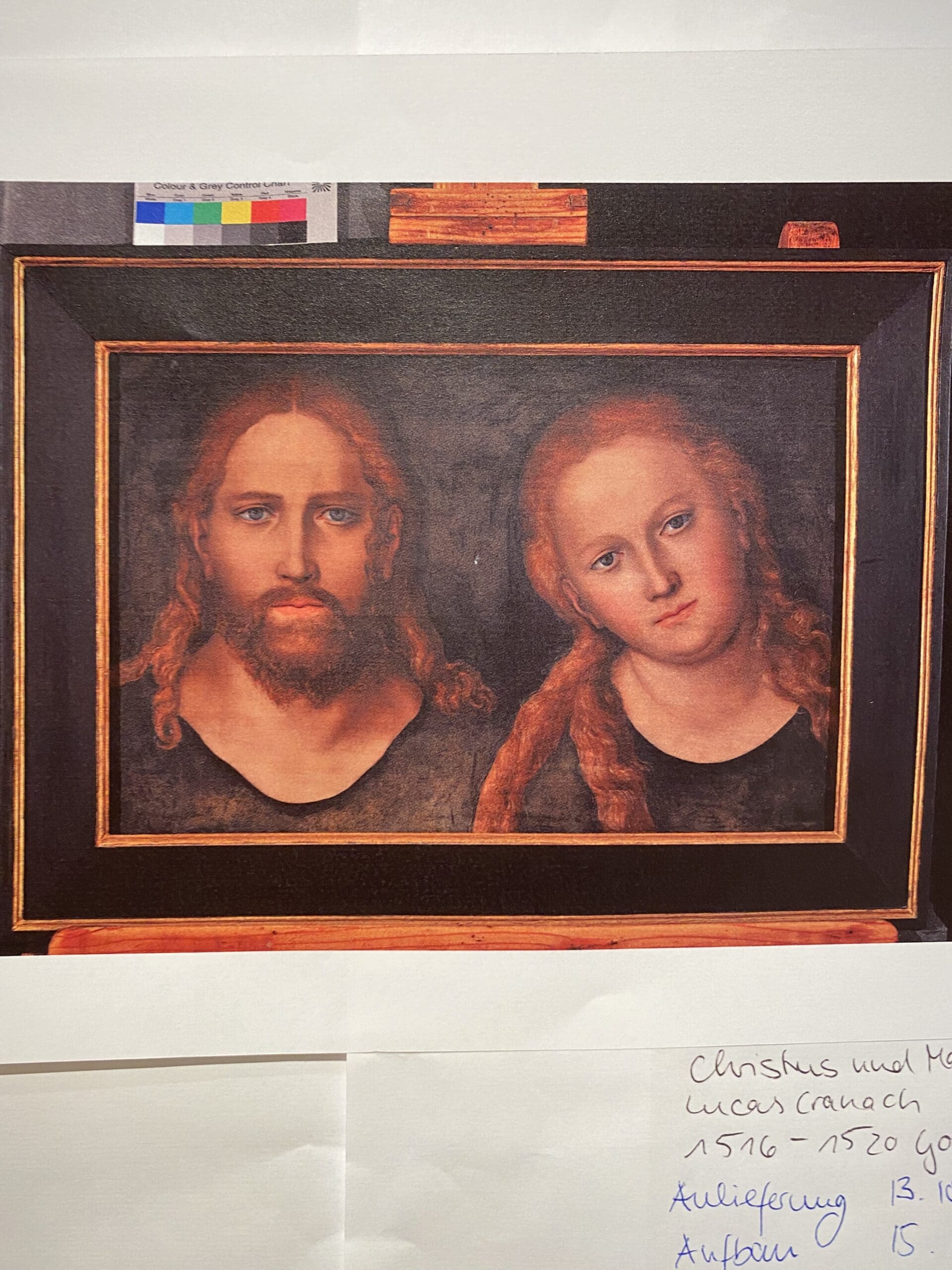
Christ and Mary, circa 1510, Friedenstein Castle Foundation
Discover Kemmer and Cranach interactively
An important goal of the exhibition organizers is to appeal to a broad audience. In the entrance area, an entertaining animation will provide information about the painters, as well as important social and political milestones of that time.
In addition, various exhibition-related activities are offered for all age groups, such as a creative detective kit for children, computer games for teenagers, and an interactive city walk through Lübeck to the locations and places that were relevant to some of the wealthy protagonists of the exhibition. These locations are marked with a red "K" in the cityscape. A QR code allows visitors to access insider information on-site: Who lived where 500 years ago? Who knew whom? What were their professions and what roles did they play in the city? Aren't these precisely the questions that still fascinate us today?