
Every city of note has at least one luxury hotel. A meeting place for the rich and beautiful. As the premier destination for upper-class travelers, these establishments often tell fascinating stories, frequently intertwined with the fate of the city itself.
Wusstest du, dass es auch in Lübeck einst ein Luxushotel gab – und das schon viel früher als in unseren heutigen Metropolen? Und hast du dich schon einmal gefragt, was es mit den beiden Lübecker Löwen auf sich hat, die heute das Holstentor flankieren? Was das eine mit dem anderen zu tun hat, erfährst du in diesem Artikel unserer Lübeck ZWISCHENZEILEN.

Success through innovation
Die Rede ist vom „Hotel Stadt Hamburg“. Am Klingenberg gelegen war es einst die feinste Adresse am Platz und auf seinem Höhepunkt das größte Hotel Lübecks. Es vereinte Luxus, Stil und modernste Annehmlichkeiten. Sein Schicksal ist eng mit der neueren Entwicklung unserer Stadt verknüpft. Warum aber dieser Name? Ein Gasthaus nach einer anderen Stadt zu benennen, ist durchaus nicht unüblich und lässt sich mit Sehnsucht und Fernweh erklären oder vielleicht auch dem Heimweh des Besitzers. In Lübeck hatte die Namensgebung einen ganz pragmatischen Grund: 1444 kaufte die Stadt Hamburg für 600 Lübeckische Pfennige das Haus am Klingenberg, damit ihren Abgesandten während der Hansetage eine angemessene Unterkunft zur Verfügung stünde.
Die erstmals 1519 als „Hamburger Herberge“ erwähnte Unterkunft verfügte über einen Weinkeller und machte schon bald von sich reden. Zu den früheren berühmten Gästen zählten Wilhelm von Humboldt und der Dichter Joseph Freiherr von Eichendorff, der in seinem Tagebuch vom kosmopolitischen Flair und dem ausgezeichneten Service schwärmte, für den das Hotel Stadt Hamburg schon damals bekannt war.
Die eigentliche Erfolgsstory begann im Jahre 1817 als Georg Theodor Pflüg das Haus übernahm und fortan unter dem Namen „Hotel Stadt Hamburg“ führte. Gegen den erheblichen Widerstand der Lübecker Unternehmerschaft ließ er in seinem Gasthaus Bäder einrichten. Eine unglaubliche Innovation für die damalige Zeit, denn im beginnenden 19. Jahrhundert war das Baden keine Selbstverständlichkeit. In Gasthäusern bot man Reisenden einen Krug mit Wasser zum Händewaschen und Benetzen des Gesichts. Innovative Hydrotherapien versprachen Heilung durch Wasser. Für einen Gastbetrieb stellten Bäder damals jedoch noch einen untypischen Luxus dar. Die Lübecker Barbiere verklagten den Besitzer wegen unlauterer Konkurrenz, da sie um ihre Kunden fürchteten.
Meeting place of the rich and beautiful
In addition to these modern amenities, the regular steamship connections to Copenhagen, Stockholm, and St. Petersburg were a key factor in the hotel's success. Lübeck had always been a bridge between Northern and Central Europe. During the Hanseatic League era, this was a crucial locational advantage, and the burgeoning tourism industry benefited from it. Wealthy travelers from Northern Europe arrived on the steamships. For the Russian nobility, Travemünde was the gateway to the continent and a stopover on their way to Switzerland or France. The guest list of the "Hotel Stadt Hamburg" reads like a who's who of the European upper class of the time.

Zu den bekanntesten Besuchern des „Hotel Stadt Hamburg“ zählten die Komponisten Carl Maria von Weber und Richard Wagner sowie die Pianistin Clara Schumann – damals noch unter dem Namen Wieck. Der einflussreiche Unternehmer Werner von Siemens feierte hier mit seiner Familie. Kronprinz Friedrich III. und seine Gattin Kronprinzessin Victoria von Preußen reisten im Extrazug aus Hamburg an. Prinz Napoleon III. legte in seiner Yacht „Jerôme Napoleon“ im Hamburger Hafen an und kam zum Frühstück ins „Hotel Stadt Hamburg“. Der Autor Stefan Zweig verbrachte hier eine gemeinsame Nacht mit seiner zukünftigen Frau Friederike von Winternitz.
The Russian composer Pyotr Ilyich Tchaikovsky wrote in his diary:
“Oh God, what happiness! It feels so good to be sitting in a foreign city, in a beautiful hotel, and to have five whole days of peace and quiet.”
James Edward Marston beschrieb das „Hotel Stadt Hamburg“ bereits 1833 als „eins der Besten im nördlichen Deutschland.“ Der einflussreiche Baedeker-Reiseführer – der Tripadvisor des 19. Jahrhunderts – führte das Haus ab 1864. Das Geschäft florierte und das Hotel wurde durch Zukauf und Anbauten stetig vergrößert. Die prächtige Fassade zum Klingenberg wurde durch einen von Säulen getragenen Balkon ergänzt. Eine breite Freitreppe führte hinauf ins Foyer.
The advertisements of the time promised comfortable single and double rooms with running hot and cold water, baths, and showers. Such a hotel was never merely a place to sleep, but always also a meeting place for the upper crust. The "Hotel Stadt Hamburg" offered an elegant wine restaurant, a bar (at times even advertised as an "American Bar"), and a hotel garden. Dances were held regularly on weekends. Illustrious groups gathered in the hotel's festive rooms – the setting for countless events, from lavish wedding balls to occasions of national importance, such as the royal luncheon during the Kaiser's maneuvers in 1904. There was a stable for horses, a lockable carriage house for the first automobiles, an elevator, a telephone, and a landline.
How the lions came to Lübeck…
Wann betreten nun endlich die Lübecker Löwen diese Bühne? Unsere beiden heute so bekannten Wächter des Holstentors werden dem Bildhauer Christian Daniel Rauch zugeschrieben. Sie wurden 1822/23 in der Königlich-Preußischen Eisengießerei im oberschlesischen Gleiwitz gegossen. Es sind jedoch keine Unikate. Der schlafende Löwe wurde für das Grabmal des 1813 verstorbenen Generals von Scharnhorst geschaffen. Du kannst ihn noch heute auf dem Berliner Invalidenfriedhof besichtigen. Der wache Löwe beherrscht noch heute den Garten der Villa Caro im polnischen Gliwicze.

Unsere beiden Lübecker Löwen wurden vom Lübecker Konsul Johann Daniel Jacobj aus dem Katalog der Königlich-Preußischen Eisengießerei bestellt. Jacobj war das Oberhaupt einer Lübecker Kaufmannsfamilie und die Löwen ein Geschenk an seine Frau. Seit 1840 hielten sie Wache vor seinem Haus in der Großen Petersgrube 19. (Hier kannst Du mehr über diese faszinierende Straße der Lübecker Altstadt lesen)
After several decades, road and sewer construction changed the appearance of Petersgrube. The lions had to be moved and were sold to Carl Töpfers, who had by then become the owner and director of the "Hotel Stadt Hamburg." Thus, they found a new, fitting home and entered Lübeck's city history. From 1873 onward, they flanked the grand staircase of the elegant hotel – one sleeping, the other with a watchful gaze over what was then the Klingenberg hill.

Das „Hotel Stadt Hamburg“ wurde auch in der Literatur verewigt. Als Thomas Mann im Jahre 1899 aus der Schweiz ins dänische Aalsgaard reiste, übernachtete er bei einem Zwischenstopp in seiner Heimatstadt im Hotel Stadt Hamburg. Diese Reise inspirierte ihn zu seiner Novelle „Tonio Kröger“, in der er selbst das berühmte Hotel empfiehlt:
"Go to the City of Hamburg," it says. "The City of Hamburg is well-run. It costs a bit, yes, I admit, but you get what you pay for. Good food, good wines. I recommend the City of Hamburg."
Following the recommendation, the protagonist enters the "Hotel Stadt Hamburg" and while he hesitates in front of the main entrance, the narrator explains: "There was the hotel, and there were the two black lions lying in front of it, which he had been afraid of as a child."

Every end is also a new beginning.
The "Hotel Stadt Hamburg" was a success story. Its origins stretched back to the golden age of the Hanseatic League. Its end, like so much else, came on the night before Palm Sunday in 1942. The firestorm of the air raid changed the city forever. The hotel's much-praised central location became its downfall – it was razed to the ground. On Palm Sunday morning, only the porch protruded from the rubble: the balcony, supported by columns with Corinthian capitals, and – as if by a miracle – the two lions.
During the reconstruction, they disappeared from public view for several years, falling into the care of Lübeck's building authority. It wasn't until 1957 that the two cast-iron lions found their current location. There, like two sentinels, they flank the Holsten Gate, welcoming all travelers arriving in our city by train or long-distance bus. Their original owner, Consul Johann Daniel Jakobj, would likely be proud of the representative function of his lions. During his lifetime, he was deeply committed to the interests of our city. Connecting Lübeck to the newly emerging railway network of the 19th century was one of his pet projects.
The story of the "Hotel Stadt Hamburg" ended on that fateful night of bombing in 1942. Our city, on the other hand, rose from its ruins like the phoenix. Perhaps it is more beautiful today than it has ever been. We can almost see the survival of our two lions as a metaphor. Their promotion from guard post at the Hotel Stadt Hamburg to ambassadors of our city is a significant career boost. Every morning I walk past them. What fascinating historical figures they have already allowed to pass! To whom have they granted access to our city? From commuters in rush hour, to children playing and riding on their backs, to visiting dignitaries.
Try to read it in their unfathomable gaze. Whisper in their ear who you'd like to meet for a chat in Lübeck. After everything they've been through, I find it hard not to see our lions as lucky charms.
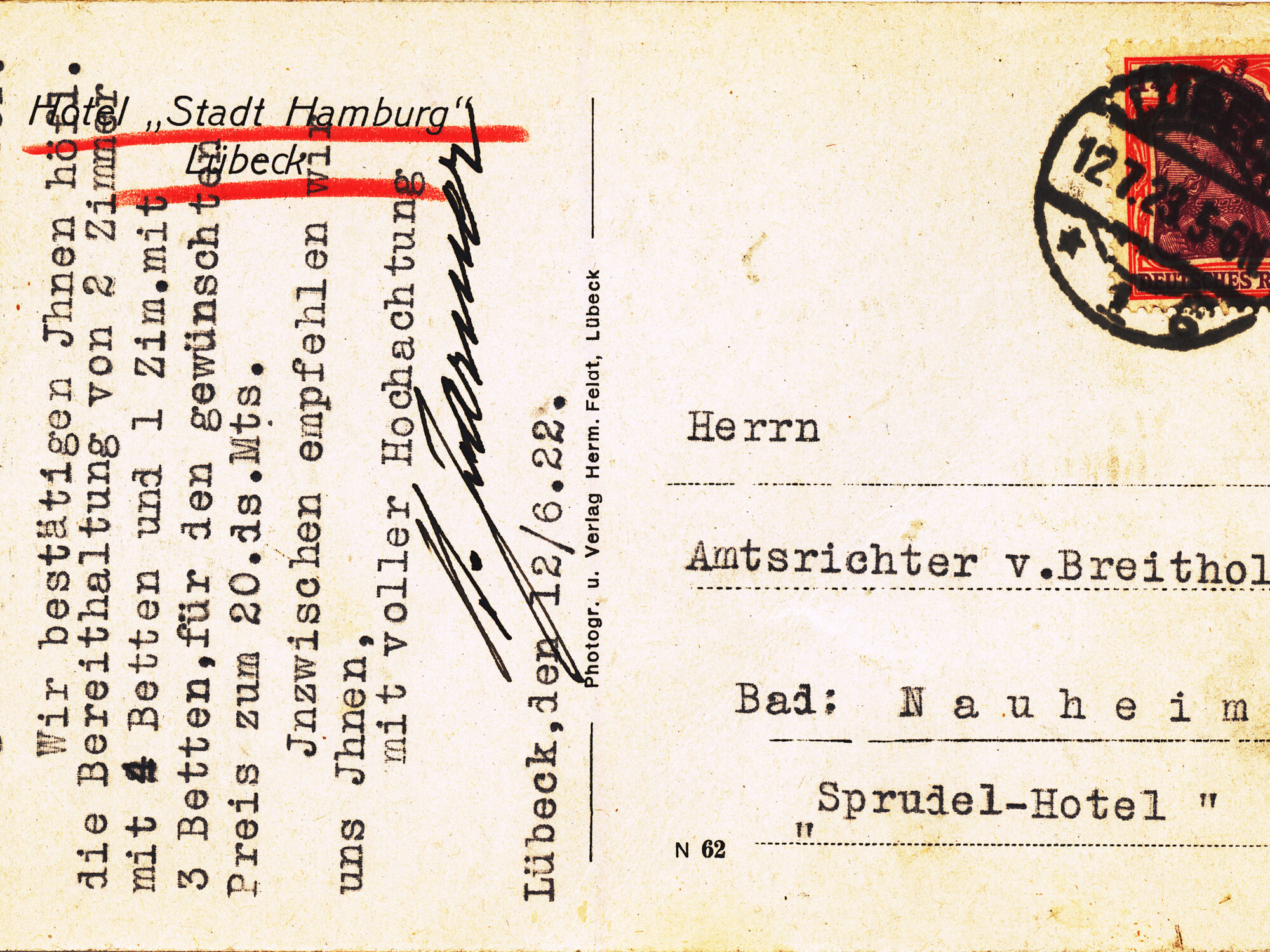
Dieser Artikel basiert auf einem bisher unveröffentlichten Buch von Guido Weinberger, das ausschließlich in digitaler Form vorliegt. Die meisten der hier abgebildeten Illustrationen stammen daraus. Es enthält viele weitere historische Details und spannende Anekdoten. Wenn dich die Geschichte des „Hotel Stadt Hamburg“ interessiert und du mehr darüber erfahren willst, dann melde dich direkt bei Guido Weinberger: gweinbergerde@yahoo.de.
The Lübeck Lions

Danke für eure/deine wunderbaren Recherchen und Beschreibungen der großartigen
lukullischen und anderen Schätze Lübecks. Ich war lange nicht mehr im Weltladen und die faire gehandelte Liubice-Schoko wird zügist gekauft u probiert!!
Wie traurig war ich, als die kleine Depandance der Lübecker BioBäckerin in der
Hüxstraße schließen musste u es später auch in der Moislinger Allee 69 Bio-Kuchen – vor allem die Florentiener – nicht mehr gab.
Also auf zum Lorenz Cafe und das Abessa aus-probieren!
Danke, die „Zwischenzeilen“ werde ich an meine Tochter weiter-mailen.
Dear Anna,
Thank you so much for your kind reply, your feedback, and your recommendation. We really enjoy writing about our city and highlighting its countless little and big secrets and quirks. Feedback like yours is a great motivation for us. I'll forward your message to Barbara, as she's the author of most of the articles you mentioned.
Have fun on your further explorations! :)
In our old farmhouse near Lübeck, we have kitchen tiles from the Hotel Stadt Hamburg that you described above. During the cleanup after 1942, the tiles were salvaged from the rubble, cleaned of stone fragments and mortar, and sold to interested buyers. Regards
Dear Mr. Scheel, this is how the hotel truly lives on. Thank you for this information!